

SEO and SEM Marketing: A Practical Guide to Growing Your Online Visibility
SEO and SEM Marketing: How to Build a Stronger Search Presence
When people need a product, service or answer, they often turn to a search engine. For businesses, appearing in those results can be a powerful way to reach potential customers. Search engine optimisation (SEO) and search engine marketing (SEM) are two approaches that help make this happen.
Although the terms are sometimes used interchangeably, SEO and SEM are not quite the same. Understanding how they differ—and how they can work together—can help businesses make better decisions about their digital marketing.
What is SEO?
SEO is the process of improving a website so that it is more likely to appear prominently in unpaid search results. It involves helping search engines understand a site and making its pages useful, relevant and easy for people to use.
SEO typically includes several areas:
- Technical SEO: Improving site speed, mobile usability, security, crawlability and site structure.
- On-page SEO: Creating clear page titles, headings and content that address the needs behind a search.
- Content: Publishing useful, accurate and original information for the intended audience.
- Off-page SEO: Building the website’s reputation through relevant mentions and links from other credible websites.
- Local SEO: Helping a business appear in location-based searches, including map results and local listings.
SEO is a long-term activity. Improvements can take time to show, but well-maintained pages may continue to attract relevant visitors without a charge for every click.
What is SEM?
SEM stands for search engine marketing. The term can be used broadly to describe marketing through search engines, including both organic SEO and paid advertising. In everyday use, however, it often refers specifically to paid search campaigns, such as pay-per-click (PPC) advertising.
With paid search, an advertiser chooses relevant keywords, writes adverts and sets a budget. The advert may appear when someone searches for a related term. Depending on the platform and campaign settings, the advertiser is generally charged when someone clicks the advert or takes another defined action.
Paid search can offer visibility soon after a campaign launches. It also gives businesses control over budgets, targeting, advert messaging and landing pages. However, visibility usually stops when the campaign is paused or the budget runs out.
SEO and SEM: The Key Differences
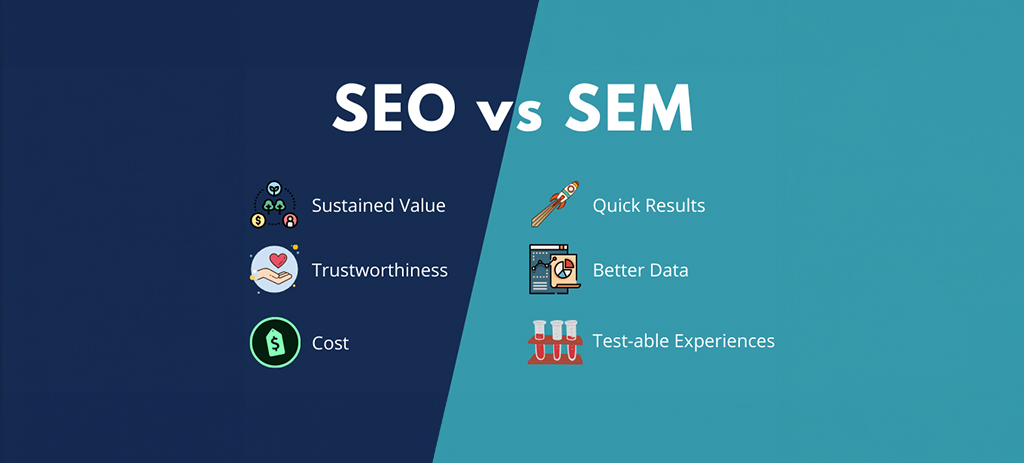
| Feature | SEO | Paid search |
|---|---|---|
| Visibility | Earned through relevance, quality and website performance | Purchased through advertising campaigns |
| Timing | Usually builds over time | Can begin soon after a campaign is approved |
| Cost | Requires investment in expertise, content and website improvements | Usually involves a budget for clicks or other campaign activity |
| Longevity | Strong pages may continue to attract visitors over time | Results depend on the campaign remaining active |
| Control | Rankings are influenced by search engines and competitors | Advertisers have more direct control over spend and targeting |
Why Use SEO and SEM Together?
SEO and paid search can support different stages of a marketing plan. SEO can build a lasting foundation, while paid campaigns can provide more immediate exposure or help promote specific offers, services or events.
Using both approaches can also provide useful insights. Paid campaigns can show which search terms attract clicks and enquiries, helping inform future content. SEO research can reveal topics and customer questions that may be worth testing in adverts.
A combined strategy can also increase a business’s overall presence on search results pages. Even so, success depends on choosing suitable keywords, setting realistic budgets and directing visitors to useful, relevant landing pages.
How to Build an Effective Search Marketing Strategy
Set clear objectives
Start by deciding what search marketing should achieve. Objectives might include increasing relevant website visits, generating enquiries, encouraging online purchases or raising awareness in a particular area. Clear goals make it easier to choose tactics and measure progress.
Understand your audience
Consider what potential customers need to know, the questions they ask and the language they use. Keyword research can help identify these searches, but it should be combined with a genuine understanding of the audience. The aim is not simply to attract more visitors; it is to attract people who are likely to find the business relevant.
Create useful landing pages
Whether a visitor arrives through an organic result or an advert, the page should match the search that brought them there. It should explain the offer clearly, answer likely questions and make the next step straightforward. A clear call to action—such as making an enquiry or booking a consultation—can help visitors decide what to do.
Make the website easy to use
Search visibility is only part of the experience. A website should load reliably, work well on mobile devices and be easy to navigate. Clear writing, accessible design and accurate information can help visitors find what they need and build confidence in the business.
Manage paid campaigns carefully
Paid search requires ongoing attention. Review keyword choices, search terms, advert performance and landing pages regularly. Negative keywords can help reduce irrelevant clicks, while well-structured campaigns make it easier to understand where the budget is going.
Measure meaningful results
Rankings, impressions and clicks can provide useful context, but they do not tell the whole story. Businesses should also monitor outcomes such as qualified enquiries, sales, conversion rates and cost per acquisition. Accurate tracking helps show whether search marketing is contributing to wider business goals.
Common Mistakes to Avoid
- Expecting instant SEO results: Organic visibility often takes consistent work and time to develop.
- Choosing keywords by volume alone: A popular search term may not be relevant or likely to lead to a valuable enquiry.
- Sending every visitor to the homepage: A focused landing page is often a better match for a specific search or advert.
- Ignoring the user experience: Poor navigation, slow pages or unclear content can undermine both paid and organic activity.
- Failing to review results: Regular analysis helps identify what is working and where changes are needed.
- Using misleading claims: Marketing messages should be accurate, transparent and appropriate for the audience and sector.
Conclusion
SEO and SEM marketing can help businesses connect with people who are actively searching for information, products or services. SEO focuses on earning visibility in organic results, while paid search can provide targeted exposure through advertising. Each has different strengths, and neither is a substitute for a useful website and a clear offer.
A thoughtful strategy brings the two together where appropriate, supports it with relevant content and landing pages, and measures success against meaningful business outcomes. With ongoing review and refinement, search marketing can become a valuable part of a broader digital marketing plan.
Five Key Benefits of SEO and SEM Marketing
- SEO can build lasting organic visibility.
- SEM can deliver targeted traffic quickly.
- Both help reach people actively searching.
- Campaign data can guide marketing decisions.
- SEO and SEM can complement each other.
Five Key Drawbacks of SEO and SEM
- SEO can take months to show results.
- Paid search costs can rise quickly.
- Competition for popular keywords is fierce.
- Search rankings and advertising rules can change.
- Poor targeting can waste budget and attract irrelevant visitors.
SEO can build lasting organic visibility.
SEO can build lasting organic visibility by helping a website appear in relevant search results without paying for each click. While improving rankings takes time and consistent effort, useful content and a well-optimised website can continue attracting potential customers long after publication. This can make SEO a valuable long-term investment, supporting steady website traffic and helping a business reach people who are actively searching for its products or services.
SEM can deliver targeted traffic quickly.
SEM can deliver targeted traffic quickly by placing your adverts in front of people actively searching for relevant products or services. You can target campaigns by keywords, location, device and other criteria, helping your business reach the right audience at the right moment. Unlike SEO, which typically takes time to build organic visibility, a well-structured SEM campaign can start attracting visitors soon after it goes live.
Both help reach people actively searching.
One of the key benefits of SEO and SEM marketing is that both help businesses reach people who are actively searching for relevant products, services or information. By appearing in search results at the moment someone expresses a need, a business can connect with a more engaged audience and attract visitors who are more likely to take action.
Campaign data can guide marketing decisions.
One of the key benefits of SEO and SEM marketing is the valuable data they provide. Insights such as search terms, clicks, engagement and conversions can show what potential customers are looking for and which campaigns are performing well. Businesses can use this information to refine their content, targeting and budgets, helping them make more informed marketing decisions over time.
SEO and SEM can complement each other.
SEO and SEM can complement each other by combining the long-term benefits of organic visibility with the immediate reach of paid search. While SEO builds authority and can attract visitors over time, SEM can help promote key services or offers straight away. Insights from paid campaigns, such as which keywords generate clicks and enquiries, can also inform SEO content, helping businesses create pages that better match what their audience is searching for.
SEO can take months to show results.
One drawback of SEO is that it can take months to deliver noticeable results. Search engines need time to discover and assess website changes, while competition for popular search terms can make it harder to improve rankings quickly. This means businesses looking for immediate visibility may need to consider paid search alongside SEO, while treating organic optimisation as a longer-term investment.
Paid search costs can rise quickly.
Paid search costs can rise quickly, particularly when competition for popular keywords is high. Every click adds to the campaign spend, and if adverts attract visitors who do not convert into enquiries or sales, the budget can be used up without delivering worthwhile results. Careful targeting, regular performance checks and clear spending limits can help businesses manage costs and improve the return on their investment.
Competition for popular keywords is fierce.
Competition for popular keywords can be fierce, making it difficult and costly for a business to stand out. In SEO, established websites may already dominate the top organic positions, and earning comparable visibility can take considerable time and effort. In paid search, strong competition can drive up the cost per click, putting pressure on advertising budgets. Businesses can reduce the impact by targeting more specific, relevant search terms and creating useful content that meets the needs of their audience.
Search rankings and advertising rules can change.
Search rankings and advertising rules can change, making SEO and SEM results less predictable. Search engines regularly update how they rank websites and which adverts they allow, so a strategy that works today may need adjusting tomorrow. Businesses should keep up to date, review performance regularly and be prepared to adapt their content, campaigns and budgets to maintain visibility.
Poor targeting can waste budget and attract irrelevant visitors.
Poor targeting can make SEO and SEM marketing far less effective. If keywords, audience settings or campaign locations are too broad, a business may attract visitors who are unlikely to need its products or services. In paid search, those irrelevant clicks can quickly use up the budget without generating enquiries or sales. With SEO, attracting the wrong audience can increase traffic without delivering meaningful results. Careful keyword research, precise targeting and regular performance reviews help ensure marketing reaches the people most likely to take action.